
The Horse Who Cheated Death
January 4th, 2004by Larry Lee Palmer | SPECIAL TO THE POST-INTELLIGENCER
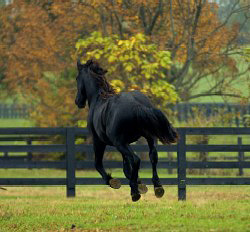
Marc Manning Photo
Kent, Washington — Outside, the rain comes down in sheets, crashing off the tin roof in a deafening roar. Inside, Jim Orr can’t hear the other horses in the long rows of stalls at Reber Ranch. All he can hear is his horse’s labored breathing. He tugs gently at the halter. “C’mon Norm, let’s get turned around. Let’s go home.”
Norms Destiny is standing on three legs, tossing his head restlessly. His hind leg is cupped, drawn upward, useless, as if a giant scoop of flesh had been torn from his hindquarter.
Orr knows he has to keep the horse moving. In the deep twilight, gusts of wind rip through the barn. He calls out, hoping another horseman can help. No one answers. He fumbles for his cell phone. Leona answers.
“You gotta get down here and help me. No one’s here and he won’t budge — the pain’s too much for him I guess. Bring some medication, honey, so we can get him moving.”
He hangs up after hearing the catch in his wife’s voice.”This just isn’t right,” he tells himself. “I know my horse — I’ll know when it’s time. You can sense when an animal gives up. Norm, he’s a fighter — that’s why he’s in this damn predicament. That’s been the trouble from day one; there just ain’t no quit in him.”
After what seemed like hours, Leona Orr appears with medication and a ranch hand. In a little while the medication begins to take effect — Norm stops tossing his head. Jim and the ranch hand get behind the horse, link arms, and push. Leona pulls gently with the halter. The horse takes a tentative hop forward, then another. Slowly, the horse limps toward his paddock.
Jim hears Leona weeping softly. He winces. Not now. Not yet.
“I’ll know when it’s time,” he thinks. “I’ll just know.”
Jim and Leona Orr and Vince Hemingson bought Norms Destiny as a yearling in 1999. They paid $5,000. Like all new owners, they had high hopes. The horse had grit. He could run — maybe in allowance company. You never know.
But after a promising training regimen, Norm lunged awkwardly out of the gate in his first race at Emerald Downs. He made up a ton of ground but the damage was done. Trying to describe the injury, they make ripping motions in the air, like something being torn apart and slammed back together.
“All we know is, his hock swelled up bigger than a soccer ball,” Jim says. “It was bone on bone. We tried cortisone. We tried ultrasound, ointment, massage, ice. Nothing worked.”
Gary Bergsma, a track veterinarian, explains: “In order to maintain circulation, a horse must use his legs. When a horse is injured and can’t put all four feet on the ground for an extended period of time, he’s in danger of foundering. Laminitis develops. Essentially that’s disintegration of the horse’s foot. In layman’s terms, it means the leg bone of a horse eventually falls through his hoof. The only humane thing to do is to destroy the horse.”
If you talk to a horse owner or a trainer or a vet, they avoid talking about putting a horse down. A concentrated barbiturate is injected into the horse’s jugular vein. It takes less than a minute. It’s supposed to be painless.
Tenderly, they load Norms Destiny into the horse trailer just before daybreak. Everyone agrees that maybe the horse can be saved if they settle him down. The problem is, his hock starts to heal and the horse immediately wants to run. The scar tissue tears again and they go back to square one.
They have to get him quieted down. Maybe turning him out at Hemingson’s farm in Lynden will work.
The trainer gently eases the trailer onto the freeway. The horse is balanced precariously on three legs. Orr grips the wheel tightly, listening for any hint of trouble in the back. Before daylight is the best chance, with little or no traffic. Still, truck-and-trailer rigs rip by, swaying the van.
If you take Interstate 5 north out of Seattle, you can get off a few miles past Marysville and take the back roads to Bellingham. You cross the Skagit River at Conway. You pass what’s left of Nasty Jack’s Antique Emporium, then the pale white steeple of an old church just over the bridge. Near dawn, shards of fog cling to low hillocks. As the sun seeps into the valley, herons begin hunting the shallows of backwater sloughs. At certain times of the year, Canada geese blot the bare winter earth of the valley floor.
Jim opens the window of his truck and listens to the cacophony of the geese at daybreak. He pulls over and the chill air makes him grab for his windbreaker. Norm is still. So far, everything is fine. Jim eases back onto the road winding through the Skagit Valley. From here he can make it all the way to the Hemingson place, Free Wind Farm, and not go over 40 mph.
Jim Orr relaxes his grip on the wheel. Things will work out. His horse will never race again, but he feels certain they can save him — maybe Norm would make a good riding horse for some kid.
But after a few weeks back home, Orr gets the phone call he didn’t want. Ranch manager Suzy Huizenga is on the line. They can’t keep the horse quiet; he is too skittish. The crows keep dropping hazelnuts on the tin roof above him and Norm goes crazy. The hock shows no sign of improvement; he keeps tearing the scar tissue loose.
Jim feels anger and helplessness. The damned horse is his own worst enemy! Curiosity gets the best of him. Out on the track, you pointed him in the right direction and he’d run through walls for you. Now back on the farm, he jumps imaginary shadows and shies from the least little noise.
Something has to be done — something nobody likes to talk about. It can’t go on like this.
Norms Destiny is vanned back to Reber Ranch in one last attempt to save his life. For three months, Jim nearly lives with the horse in his stall.
“Most horses couldn’t stand the pain,” Jim says. “They give up and that’s it.”
Instead, he fashions a Styrofoam cushion for Norm’s hoof. They hobble around the barn area hour after hour, for days and weeks on end.
Norm is on his feed again. One day, he snatches and gobbles up a peanut butter and jelly sandwich Leona meant for Jim. Everybody laughs. Everybody has high hopes. The guys down at the stable begin calling him the Silver Bullet horse, because occasionally Jim slips him a Coors Light to wash down his oats.
Then near Christmas, the horse severely re-injures his hock. Nothing can be done this time — nothing at all.
They schedule Norm’s Destiny to be put down the day after Christmas. As the day draws near, Jim can’t get the horse out of his head. All the ‘what-ifs’ and ‘maybe-thats’ swirl around inside. On impulse, he stops at the corner grocery on the way to the barn and grabs a case of Coors Light. It’s 4 p.m. but it’s already dark. Norm pokes his head out of the stall. Jim snaps the top off the first beer. What the hell difference does it make?
That night, Jim and the horse get drunk together listening to country music in the empty barn. It’s cold and damp and the wind howls and it doesn’t matter and all anybody in the outside world can hear is Willie Nelson’s disembodied voice singing “Blue Eyes Crying in the Rain.” It is time. Leona remembers all too well.
“We came to say our goodbyes Christmas Eve — can you imagine? You don’t know what it’s like to put a horse down, but at Christmas? I stroked Norm and talked to him. It sounds crazy, but it seemed like he was looking through me, it seemed like he was asking for one more chance.To make a long story short, we couldn’t do it, even though we knew we should. It was just something about this horse. He was special in a way I still can’t understand.”
The next day, Hemingson calls from Lynden. He tells the Orrs, “You’ve done everything you can — we’ve got one last idea. Bring him back up and if it doesn’t work, that’s it.”
Norms Destiny spends the winter at Free Wind Farm isolated, surrounded by mud a foot deep. There are no crows dropping hazelnuts on the tin roof — just the north wind sluicing up the Nooksack Valley. The horse can’t move much — the mud is too deep.
“Sometimes,” Jim says, “It’s like salvation is too simple to understand.”
Months go by. One day Hemingson calls and says you gotta come up. His voice sounds like he’s seen an apparition. Jim and Leona race up I-5.
Everyone watches in wonder as the horse walks around the paddock, putting weight squarely on four legs. They hug each other. Maybe the horse will live.
A few more months go by. Hemingson calls again.
“I hope you’re sitting down” he says. “That damn horse has been racing around the pasture and he’s dead fit, far as I can tell. You better come get him — he wants to run.”
Two years after an injury that should have ended his life, Norms Destiny has his first timed workout. He bores a modest hole in the wind, running three furlongs in 36 seconds and change. Impressive, considering 150-pound trainer Jim Orr is on his back.
Norms Destiny enters his first race on the long road back — an $8,000 maiden claimer at Emerald Downs in 2002. Leona can’t bear to watch the horses break from the gate. The horse has learned to run on his left lead, placing the least amount of stress on his hock. She can’t believe this is happening. As the horses round the turn, she races down the length of the clubhouse. With a small burst of speed, her horse gets up to finish fifth. Leona bursts into tears. She has just witnessed a miracle.
In that 2002 season at Emerald Downs, Norms Destiny ran fourth, and then third, and then second four consecutive times. A blurb in the Daily Racing Form suggested he had no guts — no will to win.
Too bad they didn’t discuss the issue with the horse over a tall cold one — he might have saved the prognosticator some money.
Last summer, Norms Destiny won a maiden race going away. And on July 6, Norms Destiny — the horse who didn’t have one — the Silver Bullet horse who washed down peanut butter and jelly sandwiches with beer, won a $12,500 claimer and was promptly retired with honors.
Late last month, Jim Orr took the Conway cutoff once again on his way back to Free Wind Farm. He could hear the old gladiator sniffing and snorting in the van. He wound through the valley and the fields were bottle green. The marsh grasses rippled in the hot summer wind. Herons stood like mute sentinels as he crossed the tide flats near Edison and climbed upward from the valley. He could smell the salt of the sea and watch the gyre of eagles lazy in the updrafts off Lummi Island.
Sometimes a man or a horse jumps his own shadow. Natural things don’t need names. But every once in a while the whole world just gets lucky, and everything turns out just the way it seems.

